
This study was conducted by SMERU in Jember (East Java) and in East Lombok (West Nusa Tenggara). The study findings show the number of child labourers in the study villages in the two districts reached 28.33% in East Lombok and 14.31% in Jember (child labour according to ILO definition). This figure is higher than the prevalence of child labourers at the national level which was 6.9% according to Indonesian Child Labour Survey in 2009 (Statistics Indonesia and International Labour Organization, 2009), and also higher than the prevalence of child labour in several countries in Asia and the Pacific in 2012 which, according to the ILO, was 9.3%.
Table 1. Prevalence of Working Children and Child Labourers
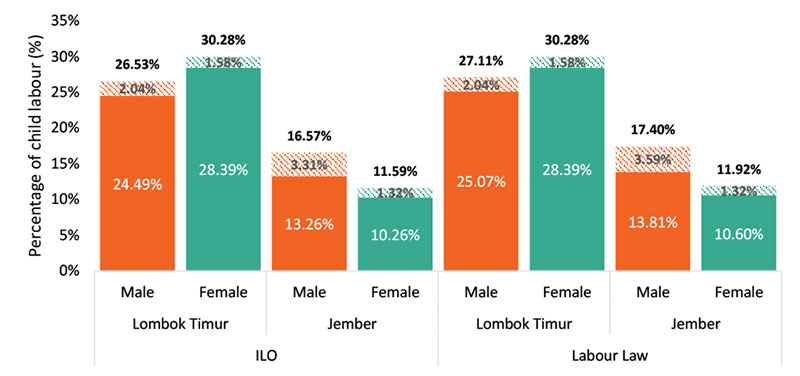
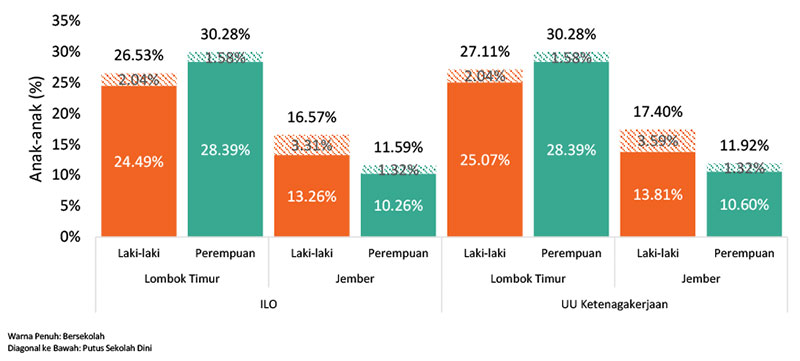
Figure 1 below shows the different patterns of prevalence of child labourers by gender in East Lombok and Jember. In East Lombok, the prevalence of child labourers is higher among girls than boys, while in Jember the prevalence of boys is higher than girls. However, according to various reports, girls are more involved in household tasks that are not considered as work (in the economic definition).
Figure 1 also shows that the prevalence of dropouts in boys is higher than girls. This might be because in overcoming economic constraints, parents tend to rely more on boys than on girls.
Figure 1. Prevalence of child labourers according to gender and education
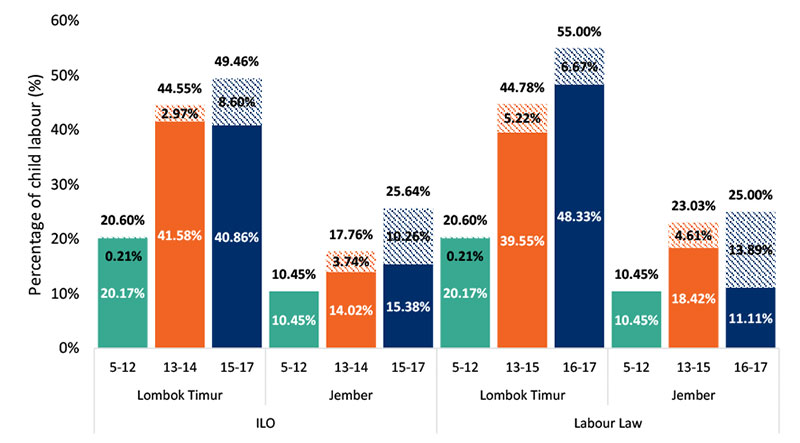
The results of this study also show a higher prevalence of dropouts in children in the older age group. Compared to child labourers aged 13-14, those aged 15-17 have a four to five times higher prevalence of dropout. Problems in Jember Regency, in particular, are more serious because 1 in 2 child labourers aged 16-17 years old has dropped out of school. Meanwhile, for the same age group in East Lombok, only one in five child labourers who dropped out of school. Most of these school dropouts are due to difficult access to education facilities and early marriage.
Figure 2. Prevalence of child labourers by age group and education
The characteristics of child labourers in tobacco farming, specifically, in terms of age and gender are different from child labourers involved in other agricultural commodities. Based on interviews with tobacco farm owners and parents, school-aged girls between elementary and junior high school (7-15 years) are more involved in tobacco farmings, while boys in the middle and high school age groups are more commonly involved in other commodity businesses. The high prevalence of girls in tobacco farmings is due to the preferences of employers (ie tobacco farmong owners or landowners) due to the repetitive nature of work that is more appropriate for women who are considered to be more patient and neat in doing work.
The prevalence of dropouts among child labourers on tobacco farmings is relatively small, as shown in Figure 3. This figure is much lower than the prevalence of dropouts among child labourers in general, as shown in Figure 2 in the previous section.
Figure 3. Prevalence of child labourers in tobacco farmings by gender, age and education
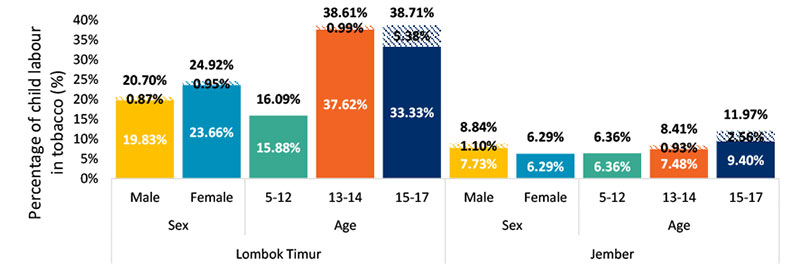
In terms of age distribution, similar to the situation of child labour in general, the older the age of the child, the higher the prevalence of child labour in tobacco farmings. In addition, older children tend to drop out more. However, the prevalence of child labour in the younger age group in East Lombok is very high when compared to national standards. This is due to exposure to work on tobacco farmings at an early age because many mothers bring their children to work.
Source: Diagnostic Study on Child Labour in Rural Areas (Special Emphasis On Tobacco Farmings), SMERU, 2019
Download PDF: Versi Bahasa Indonesia | English Version