
At the end of the year, we often look many social media posts about new year’s resolution. Some expect for the successful life, get married, have a new job, be able to go abroad, and many others. As 2019 is coming to an end, there are village mobilizer who have been thinking about the resolution, a vision for the lives of their children. Yes, they are village officials, village councils, education leaders, religious leaders who were dedicated and participated in the Workshop on Development of Child-Friendly Village Model in Jember, facilitated by LPKP, an NGO in East Java. There, they developed ideas and designed a model so that their villages can be the Child-Friendly Village.
If all this time we often hear the assessment or appreciation of the Child-Friendly District/City conducted by the Ministry of Women Empowerment and Child Protection, the concept is basically rolled out to the micro level or the closest community circle of the child, that is village level. Nevertheless, what exactly is the Child-Friendly City/District?
Child-Friendly City/District (Kabupaten/Kota Layak Anak/KLA) is a city/district that has children’s right-based development system by integrating the commitments and resources of the government, CSOs, and business sector with a thorough, comprehensive, and sustainable policies, programmes, and activities to ensure the fulfilment of children's rights and child protection.
The development of a Child-Friendly Village (Dekela) must also involve various elements and resources to ensure the fulfilment of children's rights in the area. As a starting point, it is important for community mobilizer to understand what children's rights are and the practical steps that can be taken to nurture those values. Understanding children's rights requires time and process since incorporating new concepts about children and how to pay attention and respect for children are still an unfinished homework. Not all matters discussed in the children’s right are understood and accepted as way of life. There are still tradition, views, and conservative teachings that are still strongly believed and continued. However, as time passes, children must be the centre of the development since they are the generation of the future, the ones who will become leaders. Therefore, building an environment with perspective of children’s rights should be the common goal. This is a good momentum to start designing the village where children can live properly through Child Friendly Village.
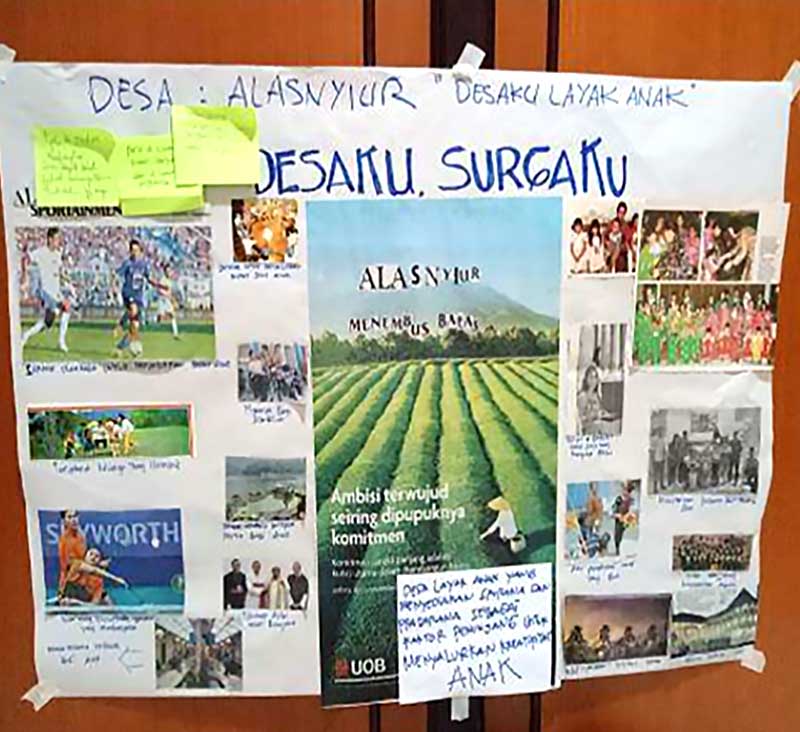
In the workshop, the village cadres discussed the theme of the ideal village for children using a collage technique. They designed the village model using information or pictures in the newspaper. Number of dream and hopes expressed by participants as a result of the collage activities. There, the ideal village is like a palace that gives hope and becomes a means to bring up children's creativity. Pictures and information displayed about arts and culture activities, care, physical development, religious harmony, higher education, adequate food and health, sports facilities, and convicted criminals are some of the descriptions of their desirable life. The result is an initial idea to be developed further into activity programmes which benefits are more tangible to the child and family. One of the villages formulated the term Pakelingan which in local language stands for Education, Creative and Environment as the target that needs to be built in order to realize the ideal village. Then, what is the next step so that the ideal village idea can be realized?
After the dream formulation session, the facilitators—Ms. Ning Sutiah and Mr. Nanang Chanan—who have been actively advocating for child protection in East Java, asked participants to start discussing in details regarding the steps to formulate the model of Child-Friendly Village. Referred to the development indicators of Child-Friendly Village—such as institutional Strengthening, civil rights and freedoms, family environment and alternative aare, basic health and eelfare, education, leisure and cultural activities, and special orotection—participants enthusiastically brought the result of the discussion as the Resolution for year 2020: My Village is Child-Friendly.
The Workshop on Development if Child-Friendly Village Model is a momentum to drive change in the village environment where the children live. Together with the cadres, we started advocating village officials, business people, and mass media to be involved in village development. Is it possible to realize the Child-Friendly Villages? With careful planning, collaboration with various parties, and communication that continues to be built, the dream is possible to be realized. The dream about the ideal village is not a mere wishful thinking. Let’s move for the change, starting in 2020! Let’s make my Village child friendly!
Notes:
*The definition is taken from the kla.id website
* Lembaga Pengkajian Kemasyarakatan dan Pembangunan, an NGO based in Malang with a focus on children's and community issues
This article was first published in Indonesiana
Author: Maria Clara Bastiani