
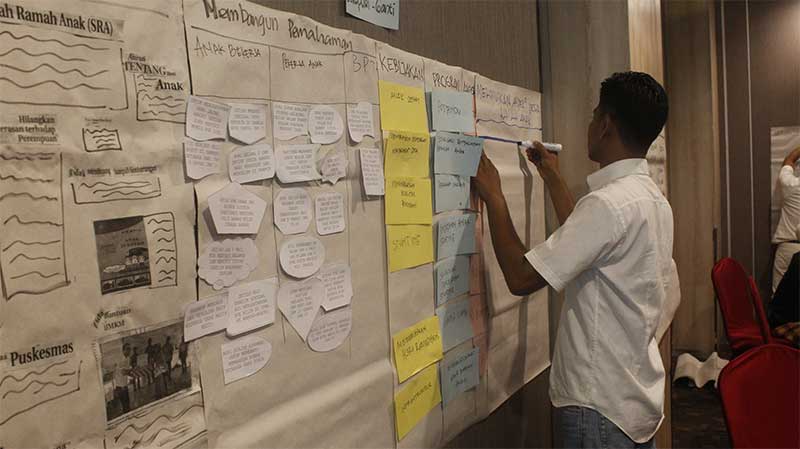
"Why is Child-Friendly City/District needed?", a question from a participant at the opening Q&A session at the workshop on Child-Friendly Village Development in Lombok last year. A question that could be raised by many when people read about Child-Friendly City/ District. Why this concept is important to be implemented, what needs to be done by the local government in order to obtain the status of Child-Friendly City/ District.
Dwi Murtiningrum, a Division Head of the Fulfillment of Children's Right, Office of Women Empowerment and Child Protection (DP3AP2KB) of West Nusa Tenggara Province, presented about the importance of Child-Friendly City/ District. "Children are God's treasure that we have to hold accountable personally and socially, require us to prepare what is best for them. Child rights shall be a consideration in the process of decision making, including in the regional development from the province, district/city and to the village."
According to Constitution of the Republic of Indonesia 1945, Article 28 B para. 2, “Every child has the rights to survive, grow and develop, and rights to protection from violence and discrimination”. Further, the Law No. 35/2014 on Amendment of Law No. 23/2002 on Child Protection Article 21:
- Para. (2) To protect the fulfilment of child rights and to carry out policies as referred to Para. (3), the Local Government is obliged and held accountable to implement and support national policies implementing Child Protection at the local level.
- Para. (5) Policy as referred to in the Para. (4) can be realized through the development of a Child-Friendly City/ District.
- Para. (6) further regulation on policies of Child-Friendly City/ District as referred to in para. (5) is regulated by Presidential Decree.
Therefore, Child-Friendly City/ District becomes an obligation and responsibility of the local government, not only to support the national policy but also as a practical endeavour to fulfil the children’s rights and protection. That being said, what is a village government responsible for? We can refer to a village responsibility to a child as a legal village citizen, stipulated in the Law No. 6/2014 on Village. Village development prioritizes community empowerment to its people's prosperity, including those who are still disempowered such as women, children, the poor, marginal groups and persons with disabilities. Children are one of the key entities to be empowered and fulfilled their basic needs in village development.
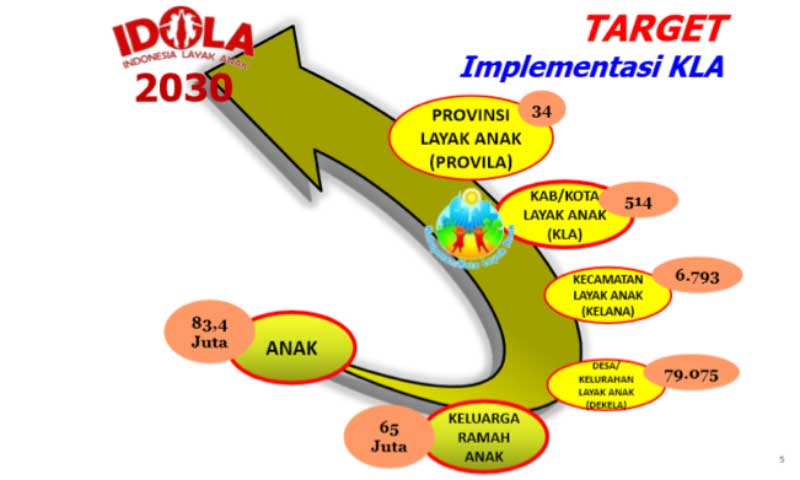
The implementation of Child-Friendly City/ District is to answer a big dream in 2030 to achieve Child-Friendly Indonesia (IDOLA)The target is a collective responsibility to achieve: 34 child-friendly provinces (PROVILA), 514 Child-friendly City/District (KLA), 6,793 child-friendly sub-districts (KELANA), 79,075 Child-Friendly Village/Sub-District (DEKELA), 65 million of child-friendly families 83,4 million children. This is indeed an ambitious target that has to be achieved within 10 years.
As a manifestation to support achieving DEKELA, Jaringan Penanggulangan Pekerja Anak (JARAK, an NGO) in partnership with LPKP (a local NGO in East Java) and with SANTAI (a local NGO in West Nusa Tenggara), has been facilitating development of Child-Friendly Village in 12 villages in 2020 and will scale up to other villages in 2021 and 2022. This initiative intends to support villages to start preparing activities for children and family development, including reaching out to the working children and their families. Aligned with the Child-Friendly Village vision, collaboration with other stakeholders--such as private sectors and media--are also being done. There are various activities involving village government, cadres, and local children to ensure sustainability. Encouraging the establishment of child friendly task force who start doing advocacy at the village level and the establishment of child forums, are also part of the strategy of implementation. This model of child friendly village will be continued with innovative activities and formulation of village regulation to address children issues and to ensure the execution of child protection agenda. The development of Child-Friendly Village model-- based upon social needs and analysis - currently is at the stage of piloting at the village level. Participation of the village community and children is critical to ensure that Child-Friendly Villages will be owned by them and the community will be able to sustain the initiative.
Realizing Child Friendly Indonesia (IDOLA) by 2030 needs hard work and supports from many actors. Non-Governmental Organisation cannot work alone, as so other organizations. Synergy and shared responsibilities among these actors, therefore, are needed because there are many villages, districts/ cities that need to be empowered and supported. Don’t we all want our children to thrive and enjoy their childhood and become the future generation of this nation? So, let’s work hand in hand to create the child-friendly environment, starting from our very own home, then to the village and district/ city and province until every place is child-friendly for Indonesian children.
Fingers crossed!
(continued)
Notes:
*Dwi Murtiningrum selaku Kabid. PHA DP3AP2KB Provinsi NTB, salah satu narasumber dalam Lokakarya Pengembangan Model Desa Ramah Anak yang diselenggarakan di Lombok tahun 2019.
*JARAR, Jaringan LSM untuk Penghapusan Pekerja Anak Indonesia.
*SANTAI, Yayasan Tunas Alam Indonesia.
*LPKP, Lembaga Pengkajian Kemasyarakatan dan Pembangunan.
Reference:
http://pkga.ipb.ac.id/wp-content/uploads/2018/05/MODUL-KELURAHAN_DESA-LAYAK-ANAK-.pdf
This article was first published in Indonesiana
Author: Maria Clara Bastiani